Feb 28 2009

Context clues work in both directions …

They both elucidate meaning, as well as obscure.

To wit:
Feb 26 2009

Stop bird porn now!

Seen along the 6400 block of N. Sheridan Road, according to rogersparkbench.blogspot.com

Seen along the 6400 block of N. Sheridan Road, according to rogersparkbench.blogspot.com

So I found this at the Chicago News Bench blog.  The author is a little bit crazy in the “socially-conservative” sense, but it’s a nice little pic snapped near my house.

Stopbirdporn.org is a real website.  I suggest checking it out.

From their front page:

“Adults, disguised as bird watchers mask their debauchery by taking trips in groups. They can then achieve climax in the safety of the woods. Particularly disturbing is the high number of senior citizens using binoculars and telescopes to observe birds mating. These horny Peeping Toms satisfy their craving for sex by focusing their debasement on birds. This perversion must be halted, otherwise the entire moral fibre of our nation is going to hell.”.

I love it.

Feb 25 2009

Layoffs can mean more than lost wages, says author

On Wednesday, Louis Uchitelle, economic reporter for the New York Times, told an audience of nearly 90 faculty and students from the University of Illinois at Chicago that layoffs had gotten out of hand in the United States, and that the consequences of mass layoffs extended far beyond the corporate bottom line.

Beyond the immediate financial impact to laid-off workers, psychological consequences can linger long after a laid-off worker has found a new job, according to Uchitelle.  “Layoffs in themselves are a truly damaging situation,”  Uchitelle said.  “In America, they’ve gone far beyond what’s necessary.”

Uchitelle said he was drawn to explore the psychological impact of layoffs as he researched his book, “The Disposable American: Layoffs and Their Consequences”.  “I consulted psychiatrists,” he said, “and they said, yes, layoffs are traumatic experiences.”

That impact can be seen in workers who give up on finding new employment or settle for any job at all, often undermining the benefits of advanced education and experience.

Uchitelle said for every three people laid off, two years later one of them had dropped out of the job market, one had a job that earned 20 percent less that the job from which they were laid off, and one had a new job making as much as their previous job.  According to Uchitelle, 19 percent of laid off workers take jobs for which they are overqualified after being laid off.

The Bureau of Labor Statistics tracks layoff events involving more than 50 employees.  According to seasonally-adjusted BLS statistics, there were 2,227 layoff events in January, involving nearly 238,000 employees.  That represents a 50 percent increase in layoff events, compared to the previous year.

However, Uchitelle said those numbers don’t take into account buyouts and early retirement, often proposed as alternatives to layoffs.  Uchitelle said that if those numbers were included in the calculations, it might be that 7 to 8 percent of all adult full-time employees suffer from the effects of layoffs every year.

Uchitelle said that it’s important to recognize the people laid off that aren’t getting jobs, and to think about the damage that causes, including the psychological as well as the financial ramifications.

“Skill is part of your sense of self,” Uchitelle said.  He said layoffs tell employees that “your skill doesn’t have value.”  Workers who have been laid off sometimes drop out of the job market completely.  “People felt so burned, they didn’t want to get back into the job market,” he said.  Uchitelle said that workers that had committed themselves to a career were more vulnerable to the psychological impact of layoffs than younger workers just entering the job market.

Uchitelle also criticized President Barack Obama’s address to Congress on Tuesday, and said that the only solution presented by the President was to replace jobs lost to layoffs with newly created jobs, a solution he said was an extension of the policies of prior administrations, and an inadequate solution.  He said that newly-created jobs aren’t equivalent to skilled positions that have been lost.

He said that he was worried that, “when we really start spending money [on economic stimulus projects] we won’t have the skilled labor to do it.”

Possible solutions that Uchitelle said should be considered included encouraging employers to cut wages across the board as a substitute for layoffs, tax credits to companies that avoid layoffs, and government wage subsidies for companies that agree to forgo layoffs.

“That debate isn’t on the horizon,” Uchitelle said.

Feb 25 2009

Beggar beats woman with crucifix

The Sun-Times is reporting that a beggar beat a woman with a 12″ stone crucifix, after the woman refused to give the beggar any money.

Pamela Johnson didn’t have cash for a woman seeking donations Saturday night, but the beggar had something for her: a beating. With a crucifix.

Johnson, 50, of the 2200 block of Tennessee Street, told police she was returning to her car about 10 p.m. when an unidentified woman approached her in the 200 block of East 5th Avenue, Cmdr. Richard Allen said.

“She said she didn’t have any money,” Allen read from the police report.

In response, the woman produced a foot-long crucifix made of stone and started hitting Johnson over the head.

Feb 24 2009

Humans associate difficult-to-pronounce words as risky and exciting

I suppose this result is unsuprising.  Novelty=risk=excitement, right?

A group of students were given a list of made-up food additives and were asked to rate how harmful they were. The additives all contained twelve letters, with Magnalroxate being one of the easiest to pronounce and Hnegripitrom one of the hardest to pronounce. The students rated the difficult to pronounce additives as being more harmful. In addition, the hard to pronounce additives were considered to be more novel than those with easier names. In another experiment, students were shown a list of made-up names of amusement-park rides and were asked to rate the rides on how adventurous they would be and how risky (and therefore most likely to make them sick) the rides would be. The names ranged from being easy to pronounce (such as Chunta) to very difficult to pronounce (such as Vaiveahtoishi). Consistent with the first experiment, the students rated the rides with the difficult to pronounce names as being more risky, but also more exciting.

Feb 22 2009

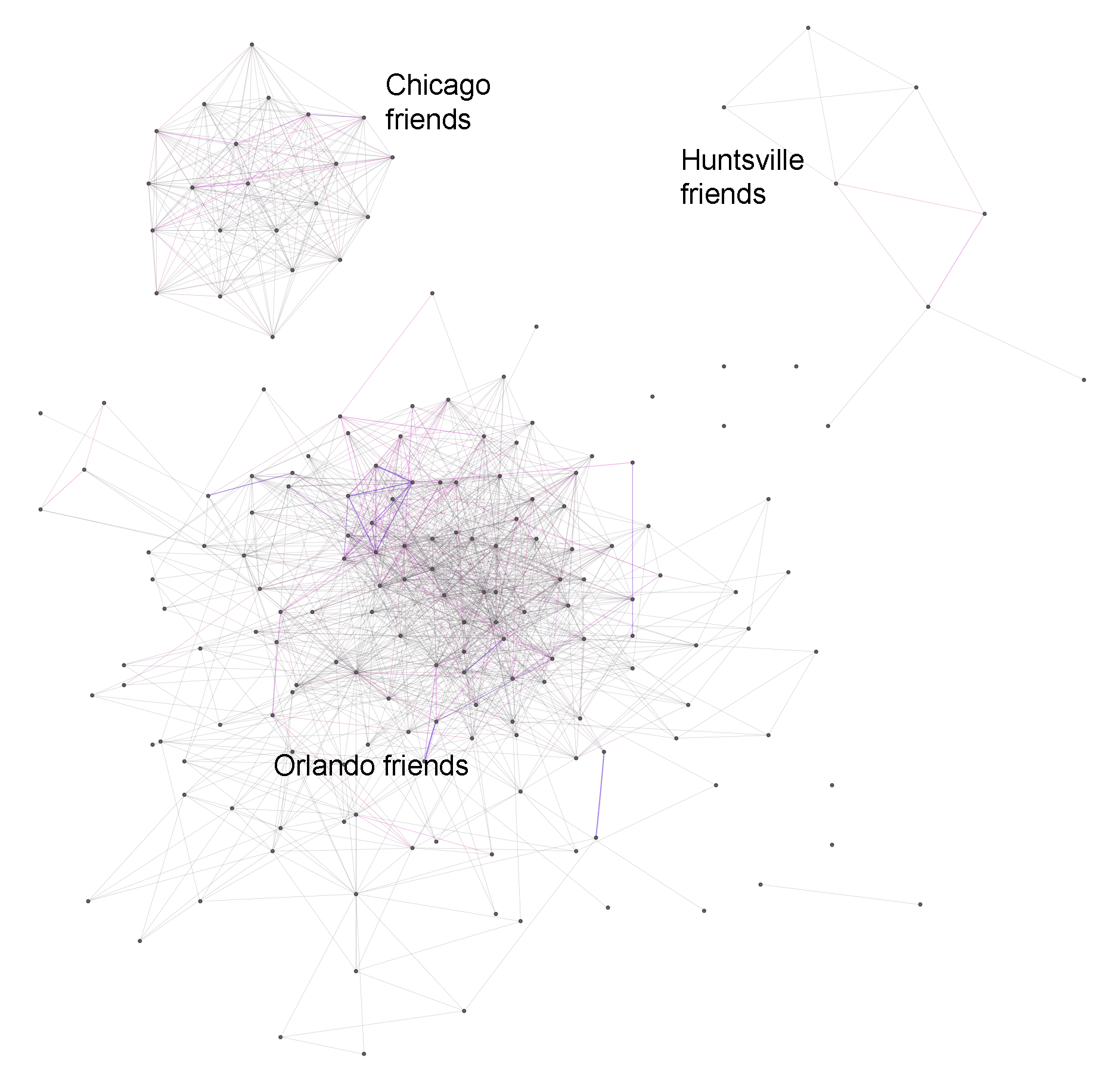
A visualization of my social networks

A visualization of my social networks, based on Facebook data.  Image generated by Nexus Friend Grapher (http://nexus.ludios.net)

A visualization of my social networks, based on Facebook data, Feb. 2009. Image generated by Nexus Friend Grapher (http://nexus.ludios.net) Click on the image for full-sized graphic

Feb 21 2009

What I’ve learned this week.

  • Skype + Pamela Call Recording Software = Good.
  • Transcribing recordings is the suck.
  • I need a tripod.  Preferrably cheap, lightweight, and small.
  • The Map Room is the second-best beer bar in Chicago.

I practically took today off, so I’ve got to make up for it by busting out some serious work tomorrow.

Plus, the planet is covered with snow again.

Feb 16 2009

The bigger the lie…

“When she tells me there are 22 caves in the Philippines guarded by 10,000 workers, guarding a treasure of trillions of pounds in precious gems and gold I do not believe her.”

Neither do I.

Feb 13 2009

U.S. Cellular Field and Wrigley Field hold nearly the same number of fans, but their economic impact couldn’t be more different

At the end of the 2008 season, the Red Line rivalry between the North Side Chicago Cubs and the South Side Chicago White Sox was tied, with each team claiming 33 wins.  Tickets went on sale Friday for their next meeting on June 16, when that tie will be broken.  But there’s at least one way that the Cubs have consistently beaten the Sox – the economic impact the team has on the surrounding neighborhood.

U.S. Cellular Field is surrounded by an ocean of concrete.  Source: Google Maps

U.S. Cellular Field is surrounded by an ocean of concrete. Source: Google Maps

In Wrigleyville, the informal neighborhood that surrounds Wrigley Field on Addison Street, game days mean a huge boon to businesses that surround the stadium.  As tens of thousands of fans flood the area, business surges at the restaurants and bars on Addison and North Clark streets.  But on 35th Street, home to U.S. Cellular Field and the 2008 American League Central division champion White Sox, fans don’t seem stick around after the game.

There’s not much reason to – U.S. Cellular Field is surrounded on three sides by 32 acres of paved parking lot, and is bounded on the fourth side by the Dan Ryan expressway.  Once leaving the ballpark, fans have to hike about a mile west to Halsted Street to find any dining or entertainment options.

Wrigley Field, on the other hand, is nestled amidst a densely populated neighborhood, filled with plentiful opportunities to separate Cubs fans from their dollars.

The International Association of Sports Economists, in a 2006 report comparing the economic impact of the two stadiums, said that this disparity was caused by treating the newer U.S. Cellular Field as a “walled fortress”, designed to maximize the amount of non-ticket revenue collected.  According to the report, the White Sox glean an extra 35% in non-ticket revenue per fan than the Cubs.

Wrigley Field, the centerpiece of a bustling neighborhood.  Source: Google Maps

Wrigley Field, the centerpiece of a bustling neighborhood. Source: Google Maps

But that’s all money that won’t be going into the tills at local businesses.

Another reason that Wrigley Field helps local businesses more than U.S. Cellular Field  is because of day games, according to the report.  The Cubs play twice as many day games at home than do the White Sox, which means fans leave the stadium in the early evening, rather than later at night when dining and shopping options can be more limited.

In a 2005 article for the Chicago Journal, Jeff McMahon said that a sensible alternative would be to develop those concrete-covered acres into a “Comiskeyville” neighborhood.  “A vibrant neighborhood on those 32 acres would not only draw fans to the stadium, it would encourage them to linger, it would attract visitors in the off season, and the land beneath those parking lots would make money all year long,” McMahon said.

The Illinois Sports Facilities Authority, the government unit that owns and manages U.S. Cellular Field, hasn’t indicated any willingness to change their game plan, however.  They even touted the completion of  a new 265,000 square feet of environmentally-sensitive water-permeable parking lot space in April of 2008.  The Illinois Sports Facilities Authority is substantially funded by a 2% hotel tax.

Sox fans do get one benefit from the sea of parking lots that their North Side counterparts miss.  Tailgating is permitted in the huge lots before games, while Cubs fans have to pay local merchants for their pre-game festivities.

That may be good for fans, but not for local business.

uscellvswrigley

Data taken from mlb.com and yelp.com

Feb 11 2009

Want to know the main problem with trying to do grad-school journalism?

Here’s the thing — journalism is transactional.  You rely on other people to feed you information that you can use to write your stories.  In exchange, your sources get to draw attention to the things that they think are important.

For instance, if you’re writing an article about a new business, you contact the business owner or spokesperson, and they talk to you, give you an interview, answer your questions, or whatever.  In return, they get to communicate their message to potential customers, they get to get the word out about their business.

Or how about if you’re interviewing a politician?  Well, again, they provide the journalist with information, and in return, they get to have their viewpoints publicized.

Perhaps you’re doing an article about health food, so you contact health experts for opinions.  In exchange for their opinions, they get their names in print, which helps to build their reputations as experts in their field.

But if you are a student, working on, oh, I don’t know, a graduate degree, for instance, and your work is only being distributed internally, or on a private website, then the transaction breaks down.  The source feeds you information, and they get nothing in return, because nobody (or only a small number of people) reads the finished reporting.

So there’s no incentive for anybody to talk to you, unless they are motivated solely by listening to themselves speak.

When I was working for the Orlando Weekly, I could simply disclose my affiliation with the newspaper, and whoever I was talking to would take me seriously enough to answer my questions.  But now that the only place that my writing is showing up is on a private website, nobody can be bothered to return my phone calls or provide me with any kind of useful information at all.  Particularly since my beat is business, where everyone is busy trying to make money, and I have nothing to offer them in the transaction of journalism.

Frankly, it’s pretty much bullshit.  Maybe I should just call myself a freelance journalist.  That would get me more respect.