Jul 29 2009

Chicago police sensitivity training video

This comes my way via Everything is Terrible! Excellent.

Jul 24 2009

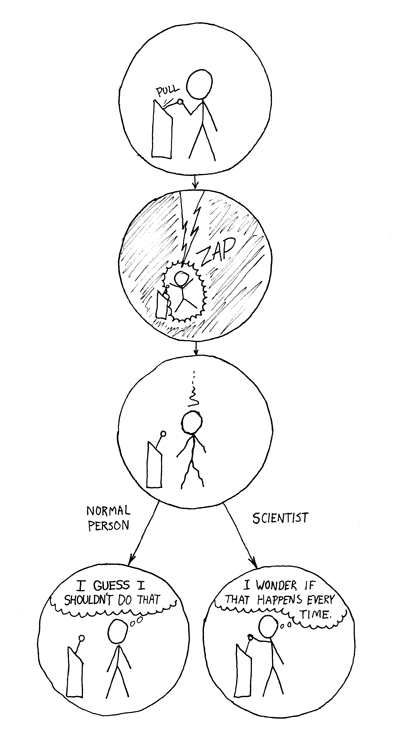
It’s like the Mark Twain story about the cat and the stove, you see.

What separates the mind of a scientist (or, more generally, a rationalist) from the average person?  Sent my way by Brother Doug.

xkcd – A Webcomic – The Difference.

Jul 23 2009

Photos from the International Museum of Surgical Science

Send us your bones, dummy!

Send us your bones, dummy!

Today, Kat and I went to view the wonders on display at the International Museum of Surgical Science, here in Chicago.

What an excellent way to spend an afternoon.  They have piles and piles of bonesaws.  Was everybody into amputation back in the olden days?

Other highlights — a full recreation of a 19th century apothecary, an iron lung, and a human skull elongated by binding.

Photo gallery here. Also accessible from my Photos page on the menu above.

Jul 22 2009

Pink Floyd’s moon landing jam session

This is kind of interesting.

Back in 1969, when man was first walking on the moon, Pink Floyd were in a BBC television studio, jamming improvisationally. There exists a recording, which has been mashed with some moon landing footage. Behold:

According to David Gilmour:

“At the time, Pink Floyd had been doing rather well. For a while, the band had been somewhat erratic and its reputation was sinking. I joined in 1968, 18 months before the moon landing. By then we were beginning to climb back up again.

It was fantastic to be thinking that we were in there making up a piece of music, while the astronauts were standing on the moon. It doesn’t seem conceivable that that would happen on the BBC nowadays.”

This little tidbit came my way via German-language site Nerdcore.de.

Jul 22 2009

Windows 7 upgrade path — if you use XP, you must wipe and reload.

Oh, man.  This is a really, really bad idea from Microsoft.  On the other hand, it’s going to mean some easy money for me.  Let me remind you, my friend, that my computer-fixin’ rates are quite reasonable.

“…Windows XP users, including the millions who have recently snapped up cheap, XP-powered netbooks, will first have to wipe out everything on their hard disks in order to install Windows 7. on their current machines. In fact, Microsoft doesn’t even call migrating to Windows 7 from XP an “upgrade.” It refers to it as a “clean install,” or a “custom installation.” This disk wipeout can be performed manually, or automatically during the Windows 7 installation process.

If you’re an XP user, the disk-wiping will cause you to lose your current file and folder organization, and all your programs, though not necessarily your personal data files themselves.

via Replacing Windows – WSJ.com.

Jul 20 2009

Should investigative journalism get a public subsidy?

Another thing that came my way via the excellent Overcoming Bias site.

The author of this piece, Paul Starr, is a professor of Sociology and public affairs at Princeton University, and he floats the idea that public subsidies of investigative journalism might be one way to combat the deluge of journalists that have given up investigative reporting, and are now turning their skills to trade pubs and special-interest public relations.

It’s an interesting idea, and I don’t entirely disagree, but I need to think more about it before I’m sure.

“Curiously enough, government subsidies that are viewpoint-neutral and that do not give officials any discretion may be a less constraining method of supporting journalism than leaving it to dependence on patrons. Today, any such subsidies should be not only viewpoint-neutral, but also platform-neutral. We need the modern equivalent of the postal subsidies of the early American republic, except that there ought to be no bias in favor of publications that appear in print.

At this point, I am not advocating any specific form of subsidy — only that we should be open to the idea. There may be lessons for America in the experience of countries that have subsidized the news media without controlling them. Many European countries, for example, exempt news publications from the value-added tax; we have no VAT, but we do have a payroll tax, and one possibility might be to exempt not just newspapers, but all recognized news gatherers from that tax in whole or part.”

Via Cato-Unbound.org .  The whole article is worth a read.

Jul 19 2009

Tweet Map mashup lets you find out what people are saying in your neighborhood

This is a neat little mash-up.

Say you want to know what people in your geographic area have to say on a particular subject.

It’s trivially easy to find out with this map of tweets by subject.

Or, to be more clear, choose a geographic area using the Google map, and then type in a search term, and it will map out recent tweets that contain your phrase.

Try it out, it’s pretty fun, and could be useful.

EgoAnt Productions: Tweet Map.

Jul 16 2009

Two Fingers – Amon Tobin side project

Two Fingers = Amon Tobin and Doubleclick.

Self-titled album available from Big Dada ( a Ninja Tune spin-off).

Here’s their Myspace page for some free samples.

You’re welcome.

Jul 14 2009

Yudkowsky – A Technical Explanation of Technical Explanation

His logic is not as strong as he'd like you to believe.

This came my way because of a thread on Less Wrong about recommended reading for new rationalists.  Eliezer Yudkowski is a very bright fellow, and this little quote comes from somewhat mathematical lesson on what constitutes a “technical explanation,” as opposed to a verbal explanation.

“Remember Spock from Star Trek? Spock often says something along the lines of, ‘Captain, if you steer the Enterprise directly into a black hole, our probability of survival is only 2.837%.’ Yet nine times out of ten the Enterprise is not destroyed. What kind of tragic fool gives a figure with four significant digits of precision that is wrong by two orders of magnitude?”

via Yudkowsky – Technical Explanation.

Jul 09 2009

YouTube – Feynman: Ways of thinking (Part One of Two)

This came my way via mental_floss, which has a bunch of videos of Richard Feynman explaining things. I like it a lot.

via YouTube – Feynman: Ways of thinking (Part One of Two).