

Nov 30 2009

State of the American Obituary report

As many of you are probably aware, I’ve spent the last couple of months working on the Interactive Innovation Project for Fall 2009.  This is the capstone project of my year at Medill.

The project has been about obituaries in print and online, and about how obituaries drive readership to local media outlets.

One of the two major pieces of the project was to produce a report on the state of obituaries in America these days.  I had a pretty large hand in this aspect of the project, as I was one of the primary authors of the report.  I’m happy to say that today, that report has been released.

From the obitresearch.com blog about the project:

“To better understand the nature of our project and the role of Legacy.com in today’s obituary publishing industry, the Fall 2009 Interactive Innovation Project team at the Medill School of Journalism has been diligently researching the history and trends of American obituary writing. We have summarized our findings in a report that we have released this morning. In this report, we examine the nature of the contemporary American obituary, a phenomenon that constitutes an important content category for modern newspapers – and, increasingly, for publishers in other media.”

Read the full post here.

Download the report (PDF).

UPDATE: Oh, hey, look at this — we got a mention on the Washington Post Post Mortem blog!

UPDATE 2: Another mention, from an Editor & Publisher blog!

UPDATE 3: An article about the report appeared in the Vancouver Sun.

UPDATE 4 (12/8/2009): A story about the report appeared on the Northwestern University website.  We also got a link from Romenesko on Poynter.org

UPDATE 5 (12/11/2009): The AP wrote a story about the report, mentioning me by name.  That AP story has gotten republished all over, and even ended up on NPR’s Morning Edition.  Today, Michael S. Malone did an opinion piece for ABC News, which also mentions our report prominently.  Another article on Canada.com.  Oh, hey, look at this!  My buddy Jeff Billman wrote it up for a blog on the Philadelphia City Paper.  Here’s another article on Examiner.com.

Aug 29 2009

Understanding complex adaptive systems

One example of a complex adaptive system is the beautiful Japanese garden in Golden Gate Park.

The Japanese garden in Golden Gate Park in San Francisco is one example of a complex adaptive system.

So this is an interesting thing.

I had two classes this quarter at Northwestern University, and they both had similar, but seperate objectives.

  • First, it was a project to highlight my interactive graphic design skills.
  • Secondly, it was a project to highlight my interactive storytelling skills.

Ok, so with the approval of the instructors for both classes, I created this microsite on the subject of complex adaptive systems.

Complex adaptive systems are one way to model lots and lots of different kinds of things that happen in the universe, at a variety of scales.  CAS models are used to understand everything from immune system responses to macroeconomic fluctuations, to sociological phenomena.

So why not take a look at it?  Features include:

  • Fully object-oriented complex adaptive system simulator, coded from scratch in Flash CS4 (Actionscript 3).
  • Introductory movie with all kinds of appropriated images from the creative commons and Prelinger archives
  • Links to lots of complex systems resources, including a full programming framework to create your own multi-agent modeling schemes.

Understanding complex adaptive systems.

May 11 2009

Practicum week, or, slaving away in the science factories

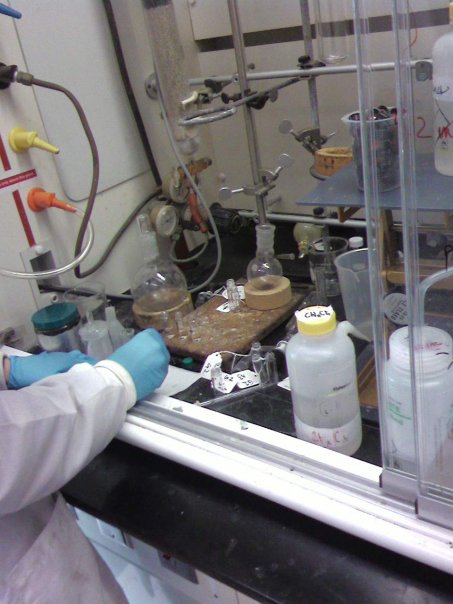
Testing what polymers came out of the experiment with Emily Pentzer

Testing what polymers came out of the experiment with Emily Pentzer

So, I spent the last week working on a practicum assignment, which was basically to hang out with some scientists, and watch and learn what the day-to-day work looks like in the universe of nanotechnology.  Luckily, Northwestern University has one of the most advanced nanotech facilities in the nation, and I was lucky enough to get to spend the week with researchers there.

First of all, I should say that the entire experience was a made much more pleasant and practical by Denise Dooley, the outreach coordinator for the International Institute for Nanotechnology. She helped set up various meetings with scientists at the Institute, and arranged for me to observe several experiments by their researchers. She was quite helpful and very courteous through the entire experience, and I owe her a big thanks.

Want to know the gory details?  Hit the jump for more:

Read more »

Apr 10 2009

Genetically engineered virus creates a better battery

MIT Professor Angela Belcher and the prototype battery she and her team created using a genetically engineered virus.  Photo credit: Donna Coveney, courtesy of MIT

MIT Professor Angela Belcher and the prototype battery she and her team created using a genetically engineered virus. Photo credit: Donna Coveney, courtesy of MIT

Researchers at the Massachusetts Institute of Technology have successfully demonstrated a technique for fabricating a better battery using a genetically engineered virus.

They announced their technique for the battery earlier this month, maintaining that it allows them to use a much wider variety of materials for potentially higher-capacity, rechargeable batteries.

The interdisciplinary team of MIT scientists combined research in biology, chemistry, engineering and advanced nanotechnology to fabricate the battery.

Dr. Chad Mirkin, professor of materials science and engineering at Northwestern University, said he is glad to see demonstrations of practical applications of nanotechnology. This represents one of the latest applications of the ongoing advances in nanotechnology using genetically modified viruses.

“There are many examples of using genetically engineered viruses to manufacture nanomaterials,” Mirkin said. “It’s a merger of molecular biology and material science.” He said that research in this area has been almost exclusively focused on batteries.

Applications of this type of virus battery may one day include powering personal electronics and even electric vehicles. The manufacturing process requires no organic solvents and can occur at and below room temperature. The process is described as “environmentally benign,” because it requires fewer toxic components, according to MIT.

To manufacture the battery, the researchers used a genetically modified strain of the common M13 bacteriophage, a virus that consumes bacteria but which is harmless to humans. By altering the virus’s DNA, the researchers were able to fabricate a battery cathode.

To do so, they altered the viruses to bond with iron phosphate on one end of their structure, and then to attach themselves to single-walled carbon nanotubes. Carbon nanotubes are used by scientists as a kind of super-small scaffolding to build nano-scale structures, and for their electric properties.

A small change in the virus’s DNA produced an affinity for molecules of iron phosphate, and these molecules were built up by the virus into a structure known as nanowires. The researchers then experimented with ways of combining the nanowires with carbon nanotubes, which are excellent conductors of electricity.

They applied the idea of modifying the virus a second time to produce an affinity for bonding with carbon nanotubes. When the researchers incubated the viral iron phosphate nanowires in a suspension of carbon nanotubes, the viruses were drawn to the nanotubes, and they produced a highly conductive network in which electrons “percolate” through the carbon nanotubes on their way to the iron phosphate.

The researchers used this network as the cathode portion of their battery, and packaged the battery in a standard coin shape. The prototype was used in a simple circuit to light a green LED, and was demonstrated last month at a White House press briefing by Susan Hockfield, president of MIT.

The prototype maintained power after being charged and discharged at least 100 times in lab tests. While this falls short of current-generation lithium ion batteries, MIT Professor Angela Belcher stated she expects to improve  performance with further research. Belcher, lead researcher for the battery project, is an expert in the fields of material science, engineering and biological engineering.

“We expect them to be able to go much longer,” said Belcher in a press release.

Note: This article was first published on the Medill Reports site, on 4/9/2009.  Reprinted here for my own archival purposes.