May 18 2010

Cognitive biases — an illustrated study guide

This is an extremely useful study guide to help you remember what kinds of biases can effect your decision-making skills.  All of us are subject to these biases, no matter how smart we think we are.  The only way to get around them is to understand them, and try to recognize them when they occur (both in ourselves, as well as in others.)

The file was created by the Royal Society of Account Planning, and came my way via Lifehacker.

Cognitive Biases – A Visual Study Guide by the Royal Society of Account Planning

May 17 2010

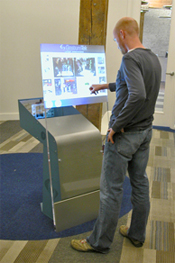
GestureTek Turns You into the Controller

Image Courtesy of: gesturetek.com

(Note – This article was first published by h+ Magazine, on May 12, 2010.  It’s republished here for my own archives.)

Chances are, you’re not using the same computer you were twenty years ago. But chances are, you’re still using the same basic user interface — a mouse for pointing, a keyboard for typing. While generations of hardware and software have come and gone, the paradigm for interacting with our machines has remained pretty much the same. But that’s slowly changing: Nintendo’s Wii system has gotten video gamers off the couch, Apple’s iPhone has acclimated us to using touch to control our devices, and a new generation of user-interface systems are beginning to come to the consumer market which promise more natural, intuitive, and engaging experiences.

Vincent John Vincent, president and co-founder of GestureTek, thinks next-generation user interfaces will be driven by movement. His company makes systems that use cameras and computer vision to watch a user’s movements, and then translate those movements into controls. “As the interfaces that we see on the screen become more dynamic and deep, with 3-D jumping off the screen or deeper into the screen, then the ability to reach out with your hand and manipulate them in that 3-D space is a much more natural way to go than just to have one point of control with the mouse,” Vincent said.

GestureTek has been building equipment and displays that respond to movement since the 1990s, according to Vincent. “We are the inventors and pioneers in this space, and luckily, early enough in it as well that we’ve been able to get a lot of patents on what we’ve done,” he said. “We’re very lucky that we were way ahead of our time for a long time, we sold thousands of installations of that technology, into museums and science centers and retail in various locations.”

“In the early 2000s, we started expanding and we created a number of different technologies that were interactive surfaces like floors and walls and windows and whatnot that would just be reacting to your motion and movement and being able to let people walk over those in front of them and just pick up your general gestures,” Vincent said. “We just found it to be very, not just natural, but engaging. It captures people’s attention, it makes the experience more entertaining and dynamic.”

And gesture controls are coming to a screen near you sooner than you might think — Microsoft’s Project Natal, which was announced at last year’s Electronic Entertainment Expo, is due to be released by Christmas of this year. Project Natal promises a 3-D, depth-sensing camera peripheral for the Xbox 360, which will use software licensed from GestureTek to enable gamers to play without any controller at all, simply by using the movements of their body. Hitachi has demonstrated a prototype HDTV that uses an embedded 3-D camera to replace the traditional remote control. Users simply wave their hand to change the channel or turn down the volume. Mobile phone manufacturers such as DoCoMo have licensed software from GestureTek as well. “We looked at the mobile phone market and said well, there is a processor, a display and a camera, what a perfect product,” said Vincent. “So we took what we had already created and evolved it even more so that we could use a phone in the hand to act like a joystick, and the camera would watch how the phone was moving in relationship to the world, or you could gesture at the phone, etc.”

The availability of depth-sensing cameras is driving the speed with which these innovations are getting into the hands of consumers. “The depth cameras that are coming to the market use infrared light and three depth sensors, so that when an array of light is pulsed out into the environment, much like an ultrasound, it bounces back,” Vincent said. “The sensors can tell how quickly it’s come back and therefore build up a depth perception of the world in front of it. It’s very similar to ultrasound but done with light. Obviously, the lenses that are capturing that information are very sophisticated and that is what has kept them very expensive up till this point in time.”

Of course, those hardware costs will drop over time. And that means one day soon, you might be able to ditch that mouse once and for all.

May 12 2010

Top 5 reasons why driving in Chicago sucks

Traffic? You're soaking in it.

So, for the first year that I lived in the city, I barely drove at all. I literally would go for weeks without so much as looking at my car.  I bought a mere four tanks of gas for the first twelve months that I lived in Chicago.

However, since I’ve been needing to get to work on time in the mornings for the last few months, I’ve been doing a fair bit of driving, between home in Rogers Park, and work in the West Loop, a commute of about 10 miles.

Now, anyone that knows me well knows that I’m a pretty safe driver.  My philosophy is that it’s more important to arrive safe, in one piece, with no damage to your car, than it is to arrive exactly “on time”.  Consequently, I follow the speed limit (generally), use my turn signals when changing lanes, and I like to do my best to be courteous to others on the road.  In exchange for these little things, the universe has generally tended to be good to me.  I’ve never been in an accident that was my fault.  I’ve gotten a ticket or two before, but you could count them all on one hand.  I’ve never killed anyone.

But I have to say, driving in Chicago is really, really a pain in my ass.  I’m sure it’s the same in every bigger city.  Here’s why:

5. The traffic.

Ok, I know, everyone hates the traffic.  There’s not much that can be done about it.  More people = more cars = more traffic.  It’s unavoidable, but I hate it still.  I mean, it can take me as much as an hour to drive 10 miles in the city.  That’s just ridiculous.

4. Bicycles.

Hey hipster, I know you’re in a rush to get to Whole Foods to pick up some tempeh for your girlfriend’s vegan potluck stich-and-bitch, but that fixed-gear ten-speed you’re riding counts as a VEHICLE.  That means you’re obligated to follow the same laws as every other vehicle.  Which means stopping at stop signs.  Which means not zooming in between cars which may well start moving on you unexpectedly.  Which means signalling when you intend to turn.  Oh, or does your zero-carbon-footprint entitle you to act like you’re the only person on the road? (Edit — this goes for you motorcycle jerks too.)

3. Parking.

So, if you have an Illinois plate and you want to park in the city, you have to buy a city parking permit.  Which authorizes you to park … well, nowhere, actually.  Anywhere you’d want to park requires you to pay.  Now, ok, fair enough, the money benefits the city, right?  Nope.  Actually that parking money goes to a private corporation.  None of it goes to the city.  Unless of course you’re parked illegally, in which case the “Department of Revenue” (oh, the delicious honesty) will ticket you.  Because you didn’t pay the corporation.  Three tickets and it’s the boot.

2. Big-ass trucks.

A week or so ago, I was driving my normal route home, when I discovered that traffic was extremely snarled in an unusual way.  After meandering for about 25 minutes to make it a mile, I saw why.  Some idiot had driven his 18-wheeler under the Loyola Red Line stop without taking into account the clearance for the trailer, and had peeled back the top of the trailer like the lid of a sardine can.

This is why we have truck routes, people.  This is why trucks are prohibited on many roads.  If you don’t know where the truck routes are, YOU’RE NOT QUALIFIED TO DRIVE A FREAKING TRUCK.

1. Taxis.

Seriously, taxi drivers, I hate you.  You are the worst.  Literally, the worst.  Your driving is like a fart on an elevator.  It stinks up the whole place, and latches on to your clothes, so the stink is still around even after you’re gone.  Taxi drivers are such terrible, terrible drivers, that they make MY driving worse, simply by being on the same road as me.

I’ve seen taxi drivers make an illegal u-turn on a one-way street.  I’ve seen them drive over medians so they wouldn’t have to turn around at the end of the block.  I’ve seen taxi drivers break every traffic law you care to name.  And they’re jackasses about it.  They routinely cut off others for no good reason, tailgate, stop short, you name it.

I’m seriously thinking about filing a FOIA request to find out how many accidents in a given month involved taxis, versus how many were simply private individuals.  I’m willing to bet that taxis are the single greatest cause of fender benders in the city.  By a wide, wide margin.

And tell me, who are they constantly talking to on their bluetooth headset?  Is the life of a taxi driver so incredible they all have to narrate it constantly to some mysterious third party?

Wanna raise money for the city?  Just deploy some cops downtown between 4:30pm and 6:30pm on weekdays, with the sole point of ticketing asshole taxi drivers casually breaking the law.  Revenue problem fixed.  You’re welcome.

May 04 2010

An update on my employment

As you can tell by looking at the dates on my recent posts, I haven’t been making too many updates lately.  Alas, how is the rabid Ian Monroe fan supposed to know what I’m up to?

Well, I’ll tell you.  I began my job hunt back in November with this post offering a bounty for tips that would lead to my next full-time job. After five months of job hunting, and lots and lots of tips from the bounty offer, I’m finally gainfully employed once again.

I started working for Leslie Hindman Auctioneers on March 1, 2010.  I’m now their IT specialist and web developer.  Leslie Hindman Auctioneers is the largest auction house in the midwest, and they (we) specialize in fine art, furniture, books and manuscripts, Asian art, vintage couture, and other, rather high-brow subjects.

I got the job through answering a craigslist ad, so nobody won the bounty.

However, I did learn some interesting things in my job hunt.

The bounty idea was extremely useful, as it netted me some freelance jobs that kept me in my home for the duration of my job search.  However, tips on full-time gigs were fewer and farther between.  I think this may have been a function of the economy in general; after all, a 10% unemployment rate means full time jobs were in high demand.

In terms of responses, it broke down something like this:

  • 1 response/interview request for every 60-80 inquiries on Careerbuilder.com
  • 1 response/interview request for every 25-35 inquiries on Mediabistro.com
  • 1 response/interview request for every 3 inquiries on Craigslist

Ultimately, Craigslist proved to be the most effective channel for soliciting work.  Didn’t expect that result, but there you go.